
Which Eagle Mountain Records Are Open
Utah law classifies each record, not each office, as public, private, controlled, or protected. That means an office may release one field while withholding another. Eagle Mountain public records also cross three levels of government. The City Recorder holds city-created material, Utah County keeps most land and marriage files, and state systems cover courts, vital events, professional licenses, and corrections.
| Record group | Keeper | Online route | Public access |
|---|---|---|---|
| Deeds, liens, plats | Utah County Recorder | Land Records | Free index and images; paid paper or certified copies |
| Owner, parcel, tax | Utah County land-record system | Owner, address, serial, map, and history modes | Free, except qualifying protected addresses |
| City council, code, cemetery, subdivisions | Eagle Mountain City Recorder | City pages or Open Records Portal | Classification and retention schedule apply |
| Justice and district court cases | Utah Courts and the relevant clerk | MyCase for parties; Xchange for public users | Public dockets; sealed, juvenile, and protected data excluded |
| Birth, death, marriage, divorce certificates | Utah OVRS, county clerk, or district court | Certificate applications and Archives indexes | Eligibility limits until statutory release |
| Voter registration | Utah County and state election officers | Vote.Utah self-lookup; file request forms | Public subset and qualified uses; protected voters withheld |
| Business and professional licenses | Utah corporations and licensing divisions | Business and DOPL name searches | Basic public verification is free |
| Jail, state custody, registry | Sheriff, DOC, registry unit | Separate official lookups | Public subset; protected case data withheld |
Recent vital certificates, sealed or expunged cases, juvenile files, protected voter details, protected addresses, and driver data are not open merely because an agency holds them. A public index can prove that an entry exists, but it may not display the whole instrument. The office that maintains the original remains the authority for copies and certification.
Eagle Mountain Records Cross Jurisdictions
Eagle Mountain is a city within Utah County, not the county seat. Its recorder manages council agendas and minutes, public notices, City Code, municipal election files, cemetery material, and subdivision records. Police reports and court files may have separate custodians. A request sent to City Hall cannot compel the city to produce a deed held by the county or a district-court file held by Utah Courts.
Most durable land and person records are in Provo. The Utah County Recorder maintains deeds, liens, plats, cross-indexes, and ownership maps. The County Clerk handles marriage licensing, elections, and county records management, while Fourth District Court holds probate, divorce, civil, and felony cases. In-person research therefore often means a Provo counter visit even when the subject address is in Eagle Mountain.
Older material adds one more handoff. If a current office no longer retains a series, search the Utah State Archives research catalog, its name indexes, or ask the agency which archive received the files. Eagle Mountain incorporated in 1996, so earlier records may be cataloged under Utah County, Cedar Valley, or a predecessor place name.
Note: The record's creator, legal custodian, and present archive may be three different entities within the same research trail.
Eagle Mountain Land Records Hub
Utah County places assessor, recorder, tax, delinquency, document-image, subdivision, serial-history, and parcel-map tools in one free Land Records menu. That uncommon combination reduces the need to jump between offices. Search modes include owner name, situs address, parcel serial, subdivision, appraisal, value, tax history, abstract, entry number and year, recording date, book and page, party name, and kind of instrument.
The portal does not state one universal online start year. Electronic entries include instruments from Eagle Mountain's incorporation era and older county land records, but coverage depends on the series. When an image or index is absent, the fallback is the Recorder counter, a mailed copy request, or an archive inquiry. The city mapping page also links to the county parcel map, while city GIS can help resolve a fast-changing street or subdivision boundary.
Why the combined portal matters. A parcel name may be an owner, a deed name may be a grantor or grantee, and a delinquency row has its own date. Each role must be read in context. No single result is a universal list of Eagle Mountain residents.
Search Eagle Mountain Recorder Records
The recorded-document party search is built around the name as indexed. Surname-first and business-name forms are common, and spelling variants can matter. An entry number plus year is the best route when those values are already known. Kind of instrument codes narrow the function of a document, such as WD for warranty deed, QCD for quitclaim deed, D TR for trust deed, or J LN for judgment lien.
| Portal field | Input | Required | How to use it |
|---|---|---|---|
| Owner Name | Text | For owner mode | Try surname or corporate-name variants |
| Property Address | Text | For address mode | Use the situs address or a street fragment |
| Serial Number | Text | For serial mode | County format such as 48:227:0016 |
| Entry Number and Year | Two text fields | For exact entry route | Opens the indexed document path |
| Name | Text | For document-name mode | Searches indexed grantor or grantee parties |
| Kind of Instrument | Code or text | For KOI mode | Select a code or full description |
| Beginning Recording Date | Date | No | Uses MM/DD/YYYY and changes result order |
The official Utah County owner-name search shows the real entry point used for Eagle Mountain property records.
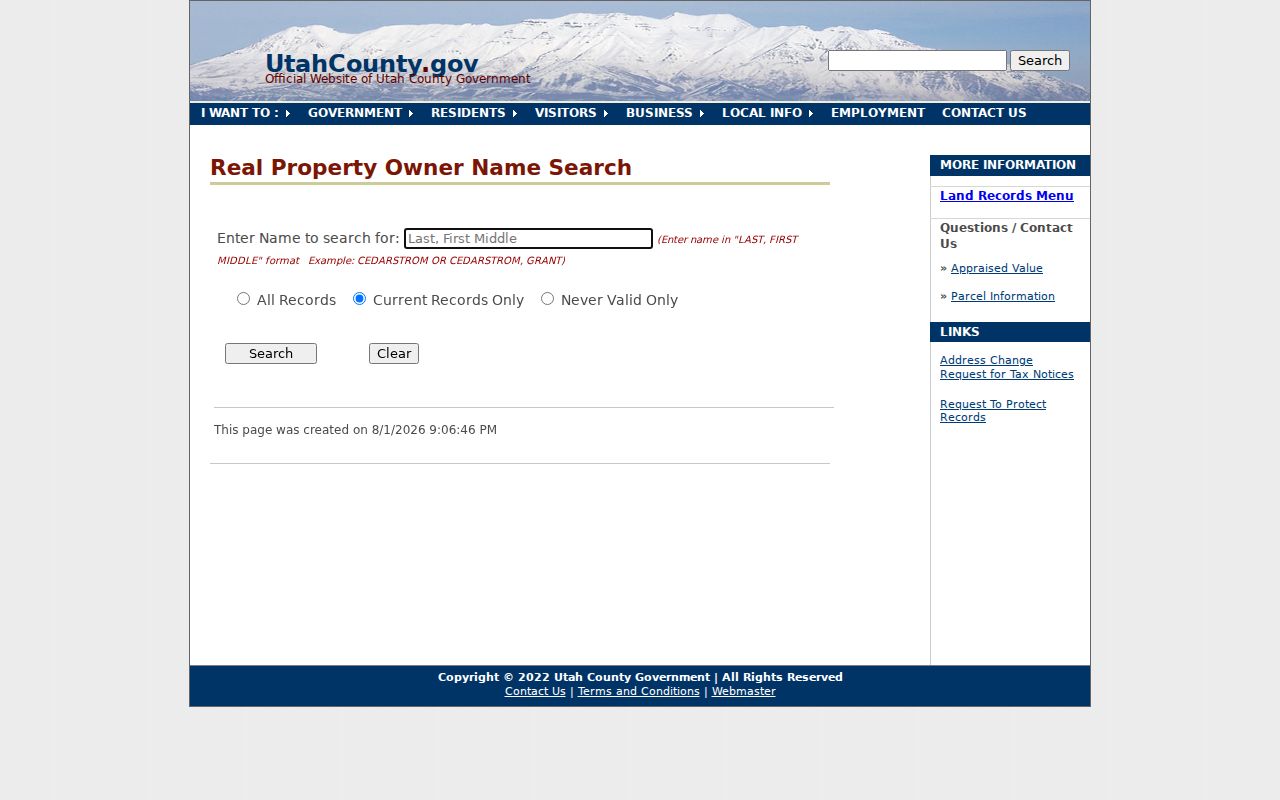
Its focused form is only one door into the wider system, so switch to address, serial, abstract, or subdivision mode when a name search stalls.
An Eagle Mountain Deed Story
Parcel 48:227:0016 gives a concrete view of how Eagle Mountain's growth entered the public record. Its abstract names Overland Trails Estates Phase I and begins with 1998 rows for a plat, city resolution, construction lien, trust-deed activity, assessor notice, and reconveyance-related instruments. A 2000 warranty deed then connects Eagle Mountain Properties LC to an individual.
The sequence is useful, but it has limits. An abstract is evidence of the chain of title, not proof that a named party now lives on the parcel. “ET AL” means other parties are attached to a row. Later releases, reconveyances, trustee deeds, or transfers may change the meaning of an earlier lien or trust deed. Read forward through the sequence before drawing a conclusion.
- Index
- A searchable list that points to a filed record; it is not always the full image.
- Certified copy
- An office-issued copy authenticated for formal use.
- Custodian
- The government entity responsible for maintaining and answering for a record.
- Exemption
- A legal reason that permits or requires an office to withhold all or part of a record.
Note: A tax-mailing address may help identify a contact route, but neither it nor the situs address proves present occupancy.
Eagle Mountain Public Records Desks
Use the office tied to the record series. City Hall takes requests for city-created files. The County Recorder answers for real-property instruments and related maps. Utah County Clerk channels differ by service, with marriages handled at one counter and elections at another. Call before travel if a file is old, archived, or likely to require staff retrieval.
Eagle Mountain City Recorder
1650 E Stagecoach Run
Eagle Mountain, UT 84005
801-789-6600
Monday through Friday, 7:30 a.m. to 5:30 p.m.
Utah County Recorder
100 E Center St., Suite 1300
Provo, UT 84606
801-851-8179
recorder@utahcounty.gov
Utah County Clerk
Marriage: 111 S University Ave., Provo
801-851-8109
Elections: 100 E Center St., Suite 3100, Provo
801-851-VOTE
Recorder web access has no access or copy charge. Paper copies cost $1 per page, certification costs $5 per document, a screen print costs $0.50, an ownership plat costs $2, and an official subdivision plat costs $4 or $2 at half size. Card processing adds 2.65 percent with a $1.50 minimum; cash and checks are also accepted.
Eagle Mountain Court Records Access
A city ordinance, traffic, lower-level criminal, or small-claims matter may be in Eagle Mountain Justice Court. Civil, felony, domestic, probate, and divorce matters belong in Utah County's Fourth District Court. Parties should try MyCase first because it is free, though it does not cover every case type. Other public users can search statewide public dockets through Utah Courts Xchange.
One-time Xchange access begins with $10 in search credit. Searches cost $0.20 and documents cost $1. The guest session lasts 24 hours, ends after 30 idle minutes, and loses unused value when closed. A subscription costs $25 to set up and $40 per month, includes 500 searches, then charges $0.35 per search; documents remain $1.
A public docket may show the case number, court, filing date, case type, party names and roles, hearings, events, disposition, and linked documents. It does not replace the clerk's file or a certified copy. Sealed, expunged, juvenile, adoption, and other protected data stay closed. For older or incomplete results, contact the relevant clerk and ask about a public terminal, copy request, or archive transfer.
Eagle Mountain Vital Records Windows
Utah's Office of Vital Records and Statistics keeps statewide birth and death certificates from 1905 to the present, plus marriage and divorce certificates for 1978 through 2010. A marriage outside that certificate interval goes to the county clerk where it occurred. A divorce outside the interval goes to the district court where it was finalized. The decree and pleadings are court records, while the divorce certificate is only a vital summary.
Utah Code §26B-8-125 opens birth certificates after 100 years, death after 50 years, and marriage or divorce after 75 years. Before then, an applicant must fit an eligible relationship, present valid identification, and provide any needed proof of kinship, guardianship, or legal authority. Applications may be made online, by mail, or in person through a local health department. Mail takes at least three weeks under normal guidance; in-person service may be same day, with last orders due 30 minutes before closing.
The official Utah certificate application routes show how record type, relationship, identification, payment, and delivery fit together.
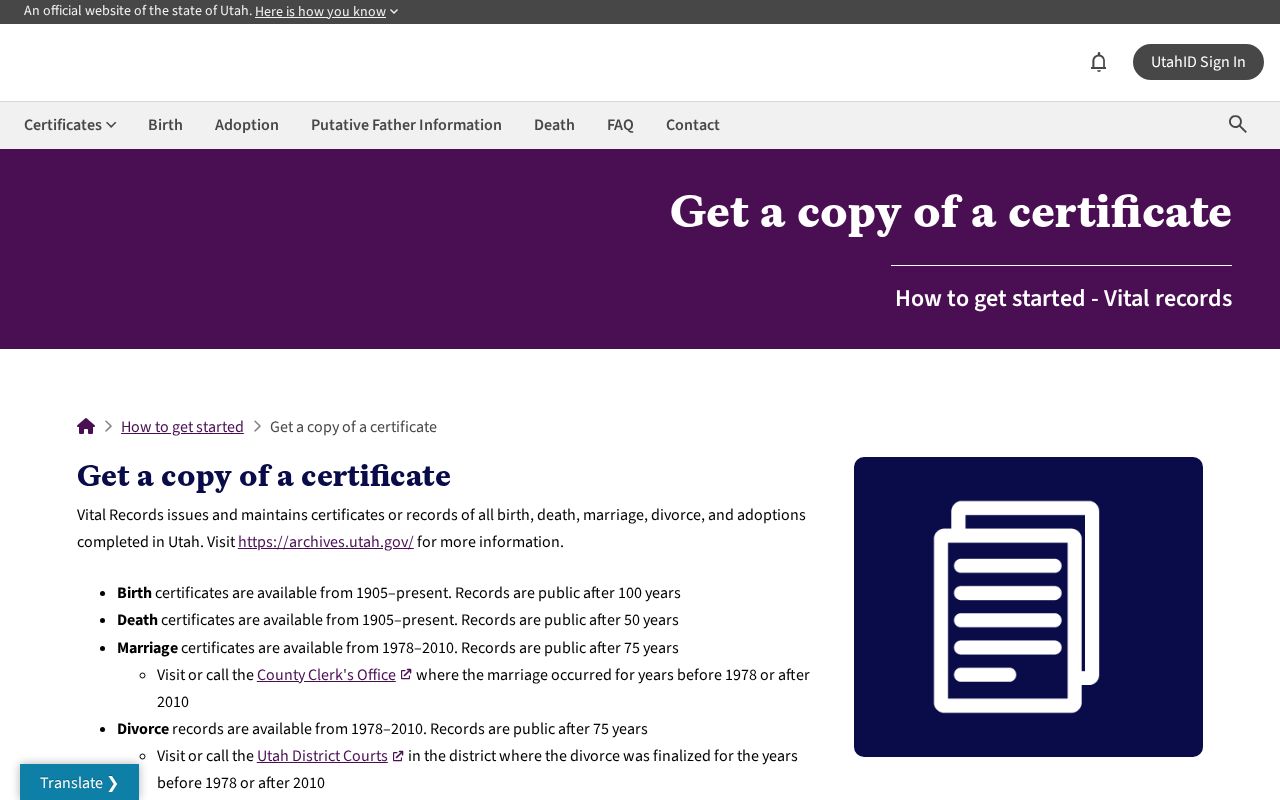
The ordering screen reinforces that a searchable historical index and an eligible request for a certified certificate are different forms of access. As of August 1, 2026, OVRS reported roughly six-week online and mail backlogs after a July fee change, so confirm the live fee and status before ordering.
Eagle Mountain Custody Record Limits
Custody searches are divided by agency. The Utah County Sheriff inmate search covers current county custody, while the Utah Department of Corrections search covers state incarceration or supervision. Federal custody uses the Bureau of Prisons locator. The Utah Sex and Kidnap Offender Registry is a separate statutory system with its own safety and lawful-use notice.
Results may include an identifier, facility or status, charges or conviction basis, booking or release data, physical description, and photo. A charge is not a conviction. Dates and scope differ by tool, so verify the agency and current status rather than merging rows from unlike systems.
For a report or data not shown online, contact the responsible law-enforcement records unit. Eagle Mountain police material may follow a police-specific GRAMA route instead of the City Recorder's general path. Victim, juvenile, medical, active-investigation, and personal details may be removed. No authoritative current Eagle Mountain police-report fee table was found, so obtain the amount directly from the custodian before ordering.
Request Eagle Mountain Public Records
Utah's Government Records Access and Management Act, or GRAMA, presumes access to records classified as public. A written request goes to the government entity that maintains the record. Include your name, address, phone number if available, and a description specific enough for staff to identify the material. A date range, department, names, addresses, case or parcel identifiers, and preferred electronic or paper format can prevent delay.
- Choose the custodian. Decide whether the city, county, court, state office, or archive keeps the record.
- Check existing access. Use the official index, public terminal, agency reading room, or posted document before asking staff to duplicate it.
- Send a written request. Use the Open Records Portal, email, fax, mail, or an in-person submission accepted by that records officer.
- Track the response. Ordinary requests are generally answered within ten business days. A qualifying expedited public-benefit request generally receives a response within five.
- Review costs and scope. The agency may charge actual duplication and permitted staff or search costs. Ask for an estimate or a public-benefit fee waiver when supported.
The Utah Open Records Portal routes a request to a selected agency and records the submission path.
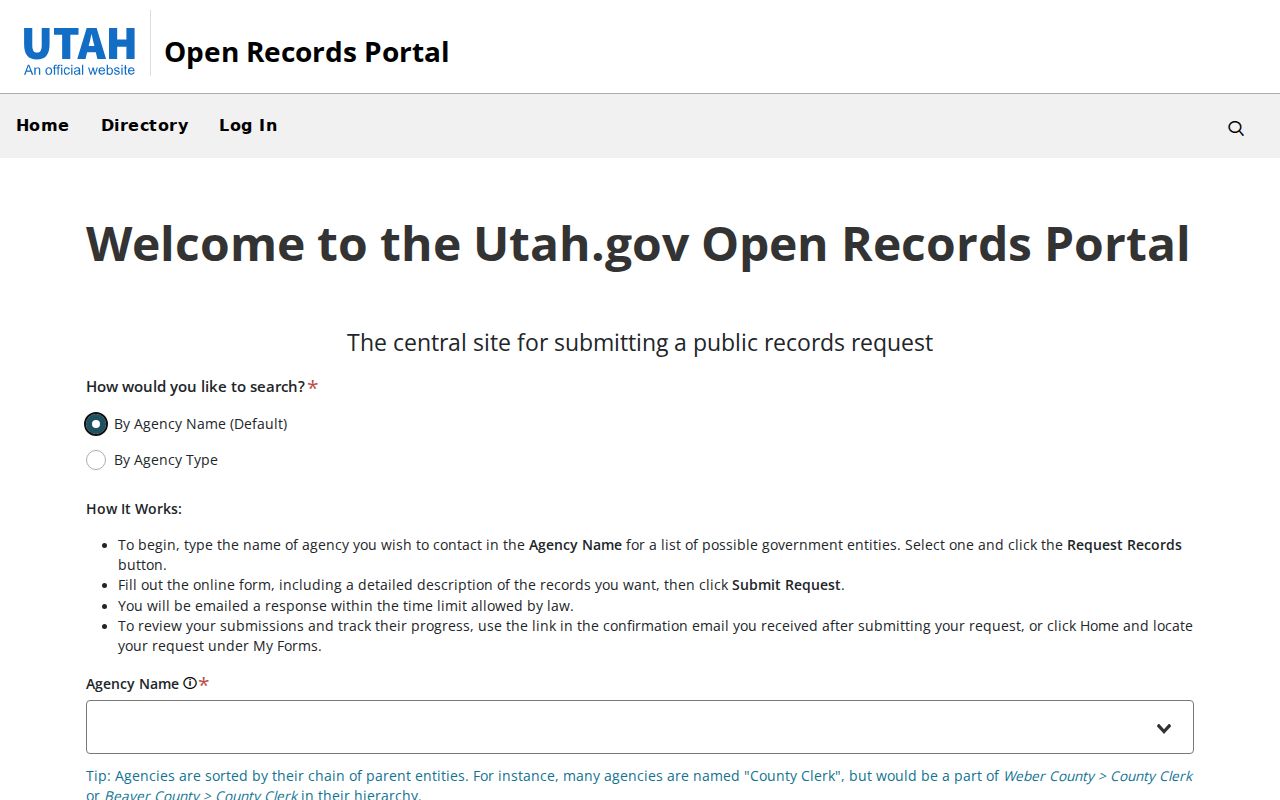
The portal is convenient, but it is not the only valid channel. Email, fax, mail, and in-person requests remain important when an agency is absent from the portal or an older series requires staff help.
Lawful personal use. Use released Eagle Mountain records for lawful research, civic review, family history, or fraud prevention. Never use a name, address, image, or status to stalk, threaten, harass, intimidate, or harm anyone.
Appeal Eagle Mountain Records Denials
A denial should identify the record classification or legal authority and state the appeal route. Keep the original request, proof of submission, response, cost estimate, and any clarification exchange. That record shows what was requested and whether the office understood the scope.
First consider whether narrowing the date range, naming a record series, or asking for releasable portions can solve the problem. GRAMA requires separation of public material when feasible. If the dispute remains, follow the agency's appeal process to its chief administrative officer. Depending on the entity and issue, further review may proceed to the State Records Committee or district court.
The Government Records Ombudsman offers mediation and process help. An appeal is different from ordering an archive copy or correcting an indexing error. If the agency says it does not maintain the record, ask which custodian or archive does. The response clock cannot turn the wrong office into the keeper of another entity's files.
Note: A precise request and a complete paper trail make both informal resolution and formal review easier.
Protect Eagle Mountain Records Privacy
Public status does not erase source-specific safeguards. Utah's Address Confidentiality Program provides a substitute address for participants. Qualified at-risk voters can protect registration details, and qualifying government employees may seek statutory property-record protection under Utah Code §§63G-2-303 and 53-18-103. Sensitive identifiers in recorded documents should be redacted under applicable law, while ordinary owner names and mailing addresses may remain visible.
The Utah Consumer Privacy Act, Utah Code Title 13, Chapter 61, provides rights over data held by qualifying private controllers. Its scope and public-record exceptions mean it is not a tool for deleting an accurate deed, court judgment, or assessment from the official source. Driver data also remains restricted under the federal Driver's Privacy Protection Act.
Commercial compilation and government correction are separate tasks. To correct an official entry, contact the custodian and ask for the applicable amendment or redaction process. To reduce a commercial listing, use that provider's privacy route, retain confirmation, limit the identification sent, and check aliases or old addresses later. The official record may lawfully remain even after a private copy is suppressed.