
Verify Eagle Mountain Voter Registration
The Vote.Utah.gov voter-information lookup is the first access channel for an Eagle Mountain voter checking their own record. It matches personal details before returning registration, ballot, and polling information. That design matters. The tool is not an alphabetical directory and should not be used to browse neighbors. The live form can change, and the official interface did not expose a complete crawlable field list during research, so the table records the identity fields documented by the current state workflow.
| Lookup control | Input type | Needed | How it is used |
|---|---|---|---|
| First Name | Text | Yes | Must match the voter record |
| Last Name | Text | Yes | Must match the voter record |
| Date of Birth | Date | Yes | Authenticates the voter; full birth date is not a public-file field |
| Residence address or ZIP | Text | Tool-dependent | Helps match identity and voting location |
| Search | Button | Not applicable | Returns self-service information or no match |
Use the form in a short sequence. Enter the name as registered, supply the requested identity details, and submit. If the record does not match, check spelling and the residence information before contacting Utah County Elections. A move within Utah County can be reported by calling 801-851-VOTE. Same-day registration follows a provisional process instead of turning the public lookup into a registration form.
The live state form is shown in the official Utah voter lookup.
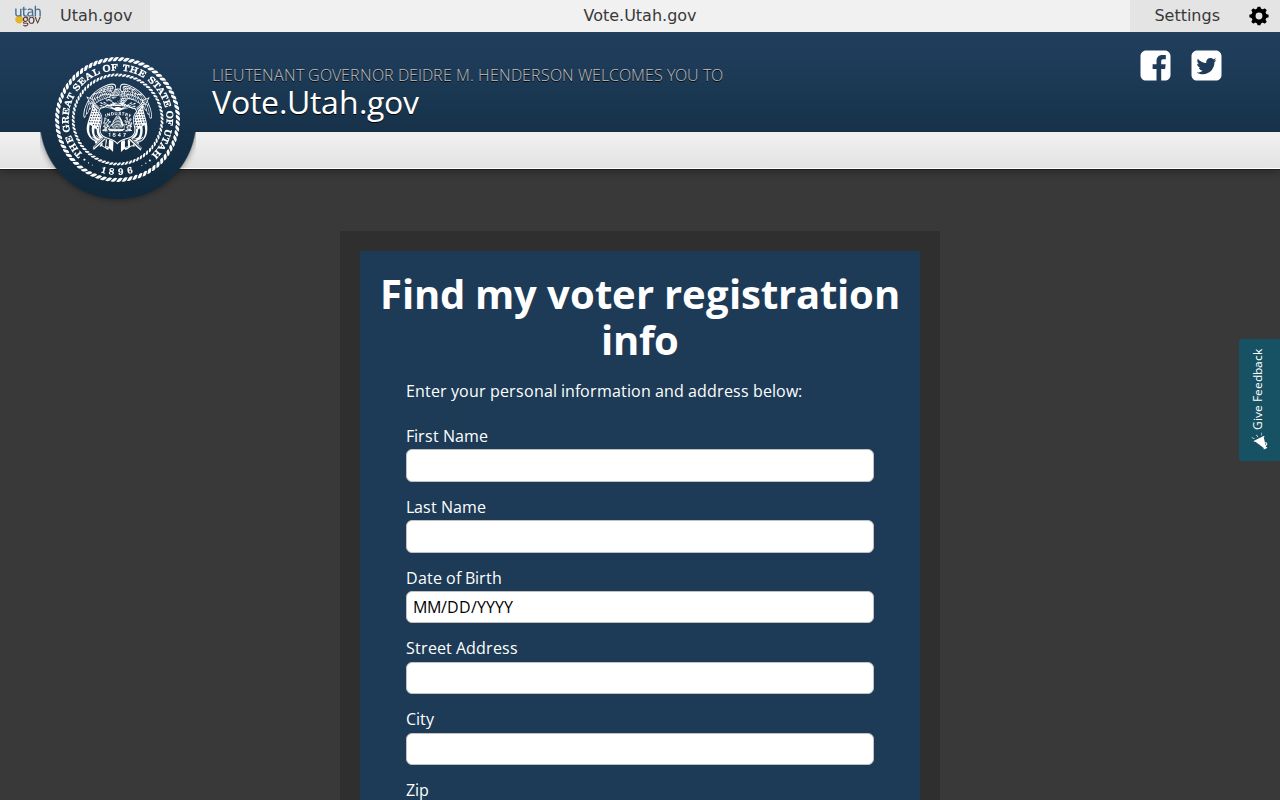
Its identity check separates a personal registration check from a request for a voter-list product.
Read Eagle Mountain Voter Records
Utah Code sets a firm line between public election data and the identity details gathered to create a registration. Under Utah Code §20A-2-104, ordinary public components include a voter's name, authorized address information, and a limited age range or year under the statute's conditions. Utah County products can also include precinct, party affiliation, political districts, registration or status fields, and participation history by election.
| Name | Included in the ordinary public file |
|---|---|
| Address | Residence or mailing data as authorized, subject to protected-voter rules |
| Party | Political party, unaffiliated, or other registration choice |
| Districts | Precinct and applicable political districts |
| Participation | Elections in which the voter participated, not selections on a ballot |
| Status | Registration fields available in the generated county product |
| Age data | Age range or year only when statutory conditions permit |
A record row therefore provides civic and district context, not proof that a person still lives at the listed address. Use the current self-lookup for your own status. A qualified voter-file request has a different purpose, different fields, and a signed use statement.
Note: Utah County states that its distributed voter products omit email addresses and phone numbers.
Eagle Mountain Voter Privacy Lines
The registration form collects more than a public voter roll reveals. Citizenship responses, residence and mailing details, party choice, signature and date, ballot-notification consent, and official-use identifiers help election staff administer the record. Collection does not make each field open. Full date of birth, Social Security number, driver license or state ID, signature, voter identifier or hash, and authentication data remain private or restricted. Email and phone information are generally restricted and may be shared with an affiliated party only when current law and the voter's consent permit it.
Confidential under Utah law. Utah Code §§20A-2-104 and 20A-2-607 withhold full birth dates, government ID data, Social Security numbers, signatures, authentication fields, and protected at-risk voter information from ordinary disclosure.
These limits apply even when a public product contains a name and address. They also explain why the self-service form may ask for a full birth date while the resulting public data does not reveal it.
Eagle Mountain Voting History Limits
Participation history is easy to misread. It marks the elections in which a person participated. It never records which candidate, measure, or position the voter selected. The secret ballot remains separate from the voter roll, and neither the state self-lookup nor an authorized county list turns individual choices into a public record.
This distinction prevents a common mistake. Election history can show that a listed voter participated in a named election, but it cannot support a claim about how that person voted. Treating participation as a ballot choice would be both unsupported and wrong.
Protect Eagle Mountain Voter Addresses
Utah provides added safeguards for voters who qualify as at risk. The at-risk classification can withhold identity and address information as the law directs, and Utah also operates an Address Confidentiality Program. These measures are not mere opt-outs from an informal directory. They are legal protections for people whose safety can depend on keeping a location out of routine disclosure.
A requester should not infer that an absent or masked entry means the voter is unregistered. It may reflect a protected classification, a failed identity match, or another lawful limit. Contact the elections office about your own record rather than trying to work around withheld data. Attempts to obtain protected voter information through false claims can carry criminal and civil consequences.
Note: A protected address is a safety boundary, not a missing field to reconstruct from other records.
Eagle Mountain Voter Roll Status
Voter status changes through election administration, not through a casual database edit. Active voters receive mailed ballots. Address changes, returned confirmation mail, death reports, duplicate records, ineligibility information, and required notice steps can move a registration to inactive status or lead to cancellation. The precise result depends on the facts and statutory process.
An inactive label should not be treated as a permanent statement about a person. The voter can use Vote.Utah.gov to check the current record and then work with Utah County Elections when a move or mismatch needs correction. Because Eagle Mountain is within Utah County and is not the county seat, county election administration is based in Provo. The City Recorder handles municipal election records and canvasses, but it does not replace the county or state voter-list system.
Request Eagle Mountain Voter Registration Data
Broader Eagle Mountain voter data is requested from the Utah County Elections Division, not extracted from the self-lookup. The office is led by Clerk Aaron R. Davidson and is located at 100 E Center St., Room 3100, Provo, Utah 84606. Staff list 801-851-8121, 801-851-VOTE, fax 801-851-8122, elections@utahcounty.gov, and weekday hours from 8 a.m. to 5 p.m.
The county's voter-information page describes the records offered, contact route, and public-file rules.
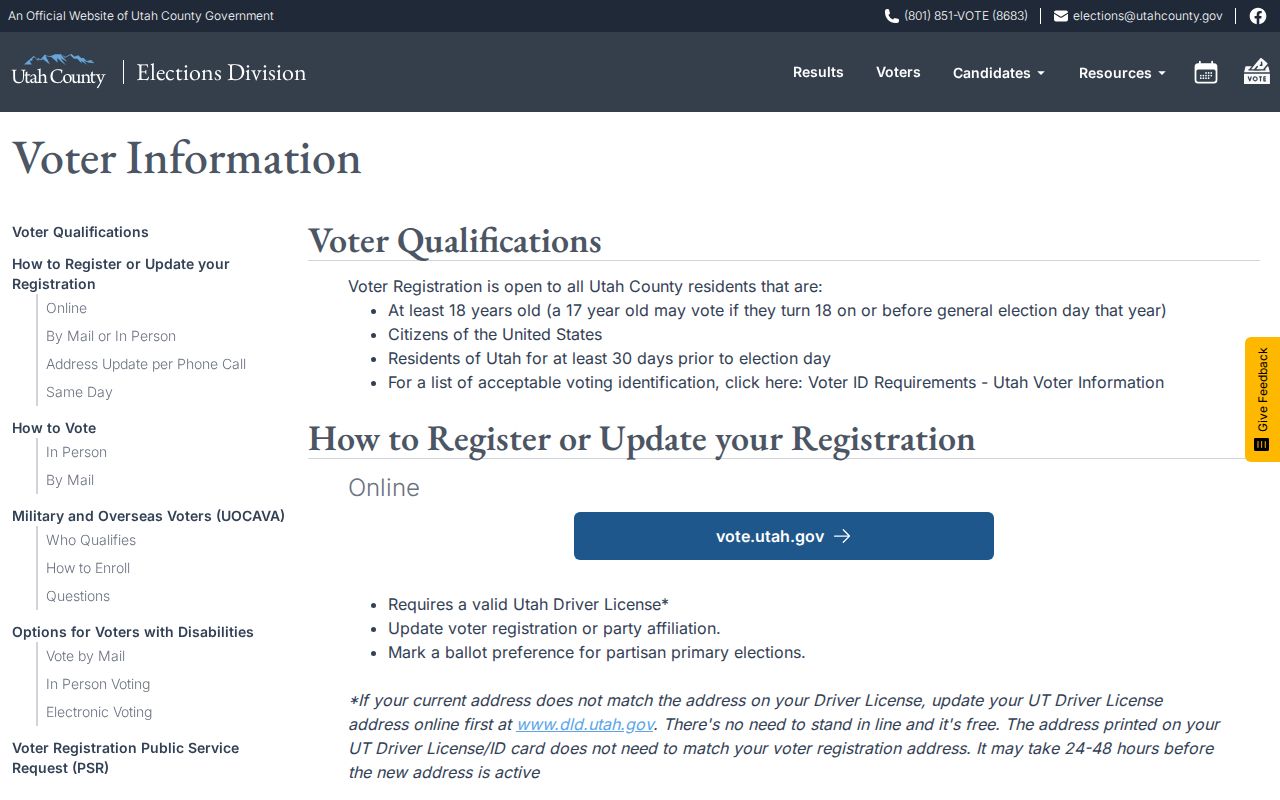
That county channel is the right fallback when the personal state lookup cannot answer a file or product question.
- Open the county Public Service Request and identify yourself with the required name, email, and mailing information.
- Select the qualified requester category, requested voter population, and the Eagle Mountain or other geographic filters that fit the lawful purpose.
- Describe the purpose, complete the statutory attestations, type the full-name signature, and submit the request.
- Wait for the invoice, pay the stated charge, and receive the generated file through the county's delivery process.
The form states a setup charge of $5 plus $1 per 500 names, processing of up to two business days, and no refund after generation. The older form describes an Excel file sent by email, while the newer voter-information page describes CSV delivery in three files. Confirm the format with Elections before paying.
Filter Eagle Mountain Voter Files
The Utah County voter-list request form is more detailed than a simple name box. Required identity fields include first and last name, email, mailing address, city, state, and ZIP code. Phone and organization are available but are not marked required. The requester must also choose the category that applies, define the voter population, state a purpose, sign, and accept the disclosure limits.
The county request interface shows the full set of filters and attestations.
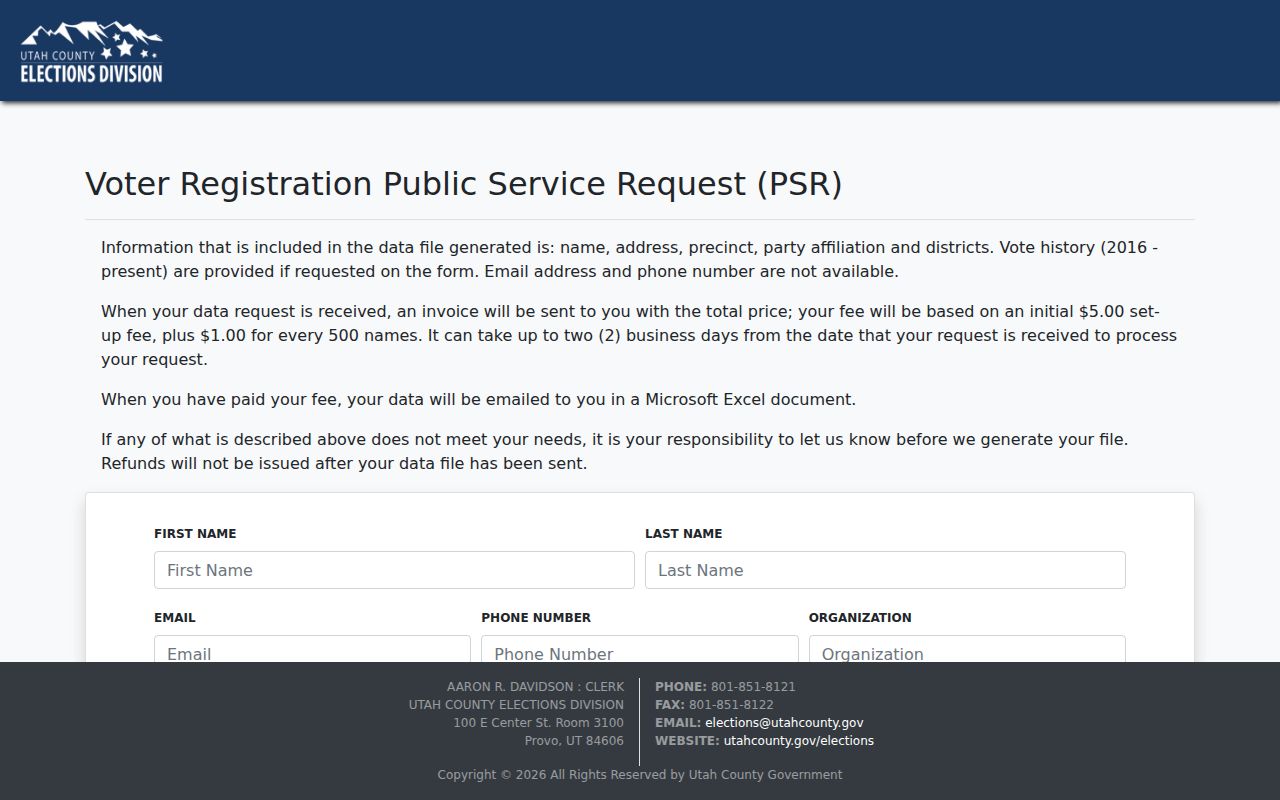
Using Residence Cities to choose Eagle Mountain narrows a county product without turning the form into an unrestricted resident search.
- Voters and party
- Choose the requested voter population, any party, or specified parties.
- Vote history
- Request participation history when permitted. The form says 2016 to present, while county narrative text elsewhere says 2015 to present.
- Precincts and districts
- Use multi-select controls for voting precincts and political districts.
- Residence cities
- Select Eagle Mountain when the request should be limited to city residents in the county data.
- Attestations
- Affirm qualification, lawful political or legal use, nondisclosure to unqualified parties, and the truth of the submission.
Note: Confirm Eagle Mountain vote-history coverage with Utah County Elections because its current official sources disagree by one year.
Compare Eagle Mountain Voter File Costs
The county and statewide voter files serve different scopes, and their prices differ sharply. A Utah County request can isolate Eagle Mountain through city, precinct, district, party, and voter-population filters. The Lieutenant Governor's statewide product is a one-time purchase of a much larger tab-delimited file. A normal spreadsheet program may not display every row in that statewide dataset.
| Product | Stated price | Delivery and scope | Update terms |
|---|---|---|---|
| Utah County voter file | $5 setup plus $1 per 500 names | County data with Eagle Mountain and other filters; confirm Excel or CSV format | No refund after generation |
| Utah statewide voter file | $1,050 | One-time tab-delimited statewide file | No subscription, refund, or later update without another fee |
The Lieutenant Governor's voter-data request also warns that election administration can temporarily freeze the product's data date. Cost does not remove the qualification or use limits for Eagle Mountain records.
Restricted use. Utah voter records may be obtained only for authorized purposes. False statements under §76-8-504 and prohibited acquisition or use can be a Class A misdemeanor, with separate civil consequences for misuse of year-of-birth data.
Trace Eagle Mountain Voter Records Historically
Modern voter files do not answer every historical question. The Utah State Archives research catalog is the fallback for poll books and registration registers. Search its series inventories by Utah County election agency, municipality, and record type. City municipal election records and canvasses may also sit with the Eagle Mountain City Recorder, while county and state election results remain separate from an individual's participation history.
There is a real coverage gap. Eagle Mountain incorporated in 1996, and official research did not confirm exact city poll-book or registration-register series and years. Earlier records from the same area may be described under Utah County or Cedar Valley rather than the modern city name. That history makes a place-name search useful, but it does not justify claiming years or holdings that the official catalog has not verified.
For general Utah access-law procedures outside voter-file rules, the Eagle Mountain public records overview explains custodian requests and GRAMA channels.
Note: Election results, canvasses, registration rolls, and secret ballots are separate record types with different custodians and disclosure rules.